A journalist of fifty years standing offers a personal and independent assessment of the often troubled relationship between public figures and the British news media.
My aim is to try to monitor events and issues affecting the ethics of journalism and the latest developments in the rapidly-changing world of press, television, radio and the Internet.
Expect too an insight into the black arts of media manipulation. So spin-doctors, Beware!
Without the ability to use the Freedom of Information Act to probe the Metropolitan Police and the Crown Prosecution Service, the Labour MP Tom Watson doubts whether a House of Commons select committee would have made the progress it did in exposing the cover-up over the phone hacking scandal at the News of the World.
He fears that the Conservative-Liberal Democrat coalition government is trying to find ways to restrict the scope of the Act – a move recommended by the former Cabinet Secretary Sir Gus O’Donnell, and a view echoed by the former Labour Prime Minister Tony Blair.
By using repeated Freedom of Information requests the Culture, Media and Sport Select Committee forced the Metropolitan Police and the Director of Public Prosecutions to reveal the contents of their hospitality registers which contained details of social engagements with News International executives.
By using the Act, the committee gained the disclosure of information which otherwise would “still be hidden” and which was far more revealing than could have been obtained by parliamentary questions to ministers.
Trade union outrage over Ed Miliband’s support for the coalition government’s public sector pay freeze – and even the prospect of wage cuts to protect jobs – has echoes of the confrontation twenty years ago when rank and file labour activists were dragged kicking and screaming into accepting Margaret Thatcher’s employment laws.
However short-lived it might prove to be, an assault on the perceived power union bosses is almost always guaranteed to win support from the Sun and other Conservative-supporting newspapers; the determination of the “Red Eds” to take on the “Reds” seems destined to provide plenty of fodder for the headline writers.
Trevor Kavanagh’s first reaction piece in the Sun to the opening salvo by the shadow chancellor Ed Balls – heralding Labour’s first step towards the endorsement of coalition policy – had a classic headline: “Labour has finally found the Balls to tackle union dinosaurs...now barons must listen”. (Sun 16 January, 2012).
Kavanagh could hardly hide his glee that the “dinosaurs who run Britain’s giant unions” were once again in the firing line. He regarded Balls’ declaration of support for the coalition’s three-year pay freeze as “effectively endorsing its entire economic austerity programme.”
Meryl Streep’s gripping portrayal of Margaret Thatcher did not do full justice to her remarkable ability to make sure that not only male politicians – but also radio and television interviewers – were kept firmly in their place. Her mere presence was enough to strike fear into the hearts of eminent broadcasters and producers.
Unlike so many of her political opponents she treated each interview as a battle for supremacy and from the moment she entered a studio and sat down in front of the microphone, she took no prisoners.
Streep’s portrayal of Thatcher in The Iron Lady captured the all-conquering nature of her Premiership at the height of her power. But some of the early scenes – as she fought to get elected as MP at Dartford and then succeeded at Finchley – did give a hint of vulnerability.
I remember my first interview with her in early 1975 – as she campaigned for the Conservative Party leadership – because there was a degree of informality which was not to be repeated. Indeed on seeing The Iron Lady I can hardly believe it myself.
Dame Elizabeth Filkin’s warning that police officers should refrain from accepting alcohol from the media has had journalists reflecting on their own misdemeanours.
My one and only attempt to emulate the subterfuge and bravado of the renowned crime reporters of Fleet Street was hardly a stunning success. I ended up footing the bill for a boozy lunch for a clutch of Scotland Yard detectives but had little to show for the hospitality which the BBC had funded.
Hard drinking went with the territory in the macho world of crime reporting in the 1970s. Journalists, lawyers, senior officers and detectives mixed freely in the watering holes around both the Old Bailey and the Royal Courts of Justice in the Strand. It was an era when reporters had more free time – and also the expenses – with which to entertain their contacts; casual conversations over lunch or a drink could easily develop into a fruitful relationship.
Armed with the right personal or private telephone numbers a reporter could by-pass the press bureau at Scotland Yard and gain tip-offs and other useful information direct from the officers concerned – and for a high-flying detective a well-placed story provided useful publicity.
If the cursory level of questioning of the Sun’s editorial executives is to be any guide, David Cameron has little to fear from the Leveson Inquiry’s brief to make recommendations on the “future conduct of relations” between politicians, media proprietors and newspaper editors.
Dominic Mahon, editor of the Sun, who was among five executives who gave evidence (9.1.2012), faced only a superficial inquiry about Rupert Murdoch’s involvement in the Sun’s endorsement of the Conservatives at the 2010 general election.
Mahon was similarly not pressed to give any details of his four meetings with the Prime Minister in the twelve months since the general election; nor was there any probing of the Sun’s political campaigning on behalf of the government.In August 2010 Cameron was given two-page spreads in the Sun to launch a hotline to expose “benefit scroungers” or another in October 2010 for the re-launch of the Prime Minister’s campaign on behalf of the “Big Society”.

 A journalist of fifty years standing offers a personal and independent assessment of the often troubled relationship between public figures and the British news media.
 Without the ability to use the Freedom of Information Act to probe the Metropolitan Police and the Crown Prosecution Service, the Labour MP Tom Watson doubts whether a House of Commons select committee would have made the progress it did in exposing the cover-up over the phone hacking scandal at the News of the World.
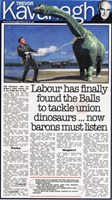 Trade union outrage over Ed Miliband’s support for the coalition government’s public sector pay freeze – and even the prospect of wage cuts to protect jobs – has echoes of the confrontation twenty years ago when rank and file labour activists were dragged kicking and screaming into accepting Margaret Thatcher’s employment laws.
 Meryl Streep’s gripping portrayal of Margaret Thatcher did not do full justice to her remarkable ability to make sure that not only male politicians – but also radio and television interviewers – were kept firmly in their place. Her mere presence was enough to strike fear into the hearts of eminent broadcasters and producers.
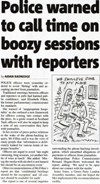 Dame Elizabeth Filkin’s warning that police officers should refrain from accepting alcohol from the media has had journalists reflecting on their own misdemeanours.
 If the cursory level of questioning of the Sun’s editorial executives is to be any guide, David Cameron has little to fear from the Leveson Inquiry’s brief to make recommendations on the “future conduct of relations” between politicians, media proprietors and newspaper editors.