
Provocative interventions by owners and editors of national newspapers have often played a pivotal role in the conduct and outcome of major industrial disputes in the long and turbulent history of strike action in Britain.
There could be no clearer illustration of malevolent interference of a press proprietor than a highly charged standoff between the Daily Mail and its print workers which became the pretext for the start of the General Strike of 1926.
By allowing the government an opportunity to claim strike action had already started – when negotiations were thought to be still in progress – Prime Minister Stanley Baldwin was able to call the TUC’s bluff.
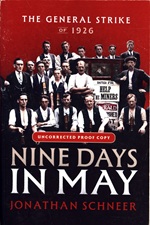
Nine Days in May, Jonathan Schneer’s new study of the strike, describes the momentous fallout from a one-sided confrontation with an anti-union newspaper, assured of government support – a scenario repeated down the decades when union leaders have tried, against the odds, and often with little success, to challenge biased press reporting.
At the height of a tense weekend of talks between unions and ministers in early May 1926, a refusal by print workers to produce the Daily Mail was the justification which the Baldwin government deployed in its declaration to end negotiations with the TUC:
“Overt acts have already taken place, including gross interference with the freedom of the press. Such action involves a challenge to the constitutional rights and freedom of the nation.
“H.M. Government, therefore, before it can continue negotiations, must require from the Trade Union Committee both a repudiation of the actions referred to that have already taken place, and an immediate and unconditional withdrawal of the instruction for a General Strike.”
Time and again all that it has needed has been the cry “freedom of the press” for print workers, their leaders and fellow trade unionists to be to be thwarted by managements bolstered by the combined strength of the newspaper industry and assured of a sympathetic hearing from the government of the day.
“For King and Country” was the title in extra-large type of the Daily Mail leader which the Sunday night shift of the National Society of Operative Printers and Assistants refused to print.
Miners’ leaders, protesting over lower wages and longer hours, were accused in the Mail’s editorial of being under the influence of people who meant “no good to this country”:
“A General Strike…is a revolutionary movement…a movement which can only succeed by destroying the government…it cannot be tolerated by any civilized government.”
The deputation of printers which went to the editor, Thomas Marlowe, did not demand withdrawal of the article but asked him, “to modify (one) offensive paragraph”.
Marlowe told the delegation to stand by while he made calls to Downing Street and the Mail’s proprietor Lord Harmsworth.
He returned to the delegation to tell the men to “either print the article as it stood or put their hats and coats on and go home”.
In trying to piece together what happened, Sheer concludes that the Home Secretary and editor decided to force the process, leaving the next move up to the TUC.
It would be full speed ahead: “they would make the printers’ act of conscience into a casus belli.”
If the TUC had gone to Baldwin immediately and disowned the printers’ action, the outcome “might have been different”.
The previous evening, after printers at the Sunday Express had objected to a government recruiting advertisement, Lord Beaverbrook was advised to back down so that negotiations could continue.
When the cabinet was told that what transpired at the Daily Mail that Sunday evening indicated that “General Strike instructions” had already been dispatched, cabinet ministers stood firm.
TUC leaders acknowledged somewhat ruefully that “war has been declared”.
All print workers were ordered to cease working to “shut down entirely” a press that was largely opposed to the General Strike.
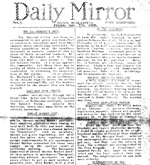
When the presses stopped rolling in Fleet Street, most national dailies and regional papers were only able to appear in a severely truncated form, some producing flimsy typewritten editions.
To fill the void the government launched its own newspaper, the Daily Gazette, published by His Majesty’s Stationery Office and edited by former journalist and Chancellor of the Exchequer Winston Churchill.
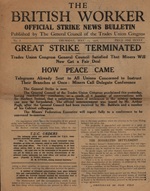
In response the TUC published the British Worker, under the leadership of the Daily Herald editor, Hamilton Fyfe.
Although circulation reached 700,000 it lacked effective distribution and failed to match the British Gazette’s circulation which rose as high as 2,000,000.
Schneer’s conclusion was that the TUC was determined control publicity during the General Strike and by publishing the “carefully edited and generally anodyne” British Worker, it hoped to persuade local strike committees to stop publishing their own “much more militant” local strike bulletins.
A rival source of news was the recently established BBC which by 1925 was being broadcast across the UK and which was being supplied with news and information by the Reuters news agency.
BBC news bulletins were a vital source of national news for small non-unionised local newspapers which upped their print runs to meet the extra demand generated by the absence of national dailies.
In an era when the press was the dominant source of news, some weekly newspapers in the suburbs printed daily editions for sale in London
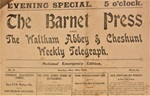
The Barnet Press, which published a daily 5’clock National Emergency Edition for central London, informed readers about the source of its news coverage.
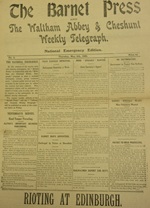
A reporter had listened to BBC news bulletins and then written up copy to deliver the latest news about the “serious pass to which this country has been reduced”.
A selection of front-page headlines gave a clear indication as to why the proprietor of the Barnet Press had not recognised the print unions: “Prime Minister stands firm”, “Rioting at Edinburgh”, “Motor cars attacked”, “Government to protect non strikers”.
Nine Days in May, by Jonathan Schneer, published by Oxford University Press,
£25.00 ISBN 9780192894533