
A right-wing playbook for thwarting trade unions which emerged from the 1976 Grunwick strike resurfaced with a vengeance a decade later during the year-long miners’ strike, contributing to the downfall of Arthur Scargill.
Finding ways to manipulate and exploit Grunwick employees who wanted to continue working was the key objective.
The same tactics were used with even greater effect to boost a return to work in the pit dispute which ultimately forced the National Union of Mineworkers to call off their strike and accept defeat in March 1985.
Events marking the 50th anniversary of the Grunwick strike have highlighted how strategies adopted by right-wing activists and provocateurs succeeded in exposing the limitations of both the trade union movement and a Labour government.
Margaret Thatcher, then Conservative opposition leader, was the beneficiary of what became a blueprint for the legislative curbs which her government introduced on taking office to limit trade union power and control strike action.
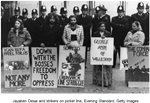
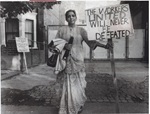
Asian women at a north-west London film processing company were led out on strike by Jayaben Desai in the summer of 1976.
Dubbed by the news media the “strikers in saris”, their legendary defiance, against all the odds became an inspiration for other low paid immigrant workers and a cause celebre for the left.
She was up against Grunwick’s resolute proprietor, George Ward, who became a figurehead for a right-wing campaign against trade unions.
Mrs Desai’s epic struggle lasted for two years, ending with a hunger strike on the steps of Congress House, headquarters of the TUC. Her humiliating defeat was a further embarrassment to the labour movement.
Faultlines in trade union procedures and practices, compounded by weaknesses and loopholes in government protection for workers, became all too apparent as far-right activists and propagandists rallied to Ward’s support and successfully fought off all attempts to force Grunwick to grant trade union recognition.
Once Grunwick dismissed the 137 strikers and they gained the support of postal workers who refused to cross picket lines – a disaster for Grunwick’s mail order business – Ward’s plight attracted immediate support from well-known trade union opponents.
Conservative MP John Gorst fronted up a parliamentary campaign, and an extra-parliamentary advance was organised by a libertarian pressure group established by Norris and Ross McWhirter, co-founders of the Guiness Book of Records.
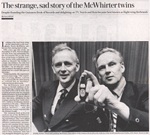
The McWhirter twins set up the National Association for Freedom (later known as the Freedom Association) in July 1975. Three months later Ross was assassinated by the IRA.
A year later, as the Grunwick dispute unfolded, Norris McWhirter was determined to disrupt trade union backing for Mrs Desai. He succeeded in marshalling support for Ward through some spectacular direct action by right-wing activists.
Their most daring exploit was early on in the strike after Grunwick’s mail had been blacked by the Union of Postal Workers. In a night-time operation 25 NAFF members with three vehicles arrived at the Grunwick film processing plant.
By 2am they had loaded up an accumulated backlog of 100,000 uncollected packages which were taken to a barn in Gloucestershire. NAFF activists licked on £12,000 worth of stamps and posted the developed photographs to customers around the country saving Grunwick from bankruptcy.
McWhirter revealed in his memoirs that Mrs Thatcher’s described NAFF’s night-time raid as the “greatest thing since the Entebbe raid” when Israel rescued high-jacked plane passengers.
NAFF was active again in the miners’ strike. Their supporters were encouraged to make constant calls to NUM area offices to block the union’s telephone lines and disrupt the organisation of the strike and the deployment of pickets.
From the start of the Grunwick dispute, Ward was encouraged to take every opportunity to mount legal action to challenge the trade unions and government-backed institutions such as the conciliation service ACAS.
By going repeatedly to the High Court – and all the way to the Court of Appeal and finally the House of Lords – Ward frustrated and defeated every attempt to negotiate union recognition and to secure the reinstatement of Mrs Desai and her fellow strikers.
A decade later astute legal action funded and co-ordinated by right-wing activists was the very same tactic pursued by David Hart, a wealthy provocateur and agitator, who regularly offered advice to Mrs Thatcher.
He operated behind the scenes, encouraging and advising working miners on how to challenge the legality of the 1984-85 miners’ strike, exploiting the failure of the National Union of Mineworkers to hold a pit head ballot.
Hart’s aim – as had been demonstrated so effectively in support of Ward – was to harass Scargill and the NUM.
Though constant legal action he hoped to replicate the success of the little people of Lilliput who immobilised Gulliver with strings across his body.
Scargill’s defiance of the courts triggered a succession of legal rulings which culminated in the sequestration of the NUM’s assets.
Seizure of the union’s funds was a consequence of the pit strike having been declared unlawful, a setback which was comparable to Ward’s successes while exploiting the legal minefield around the Grunwick dispute.
Ward’s campaign in the courts was littered with the scalps of the high and mighty.
After a controversial intervention to mediate in the dispute, the state-backed conciliation service ACAS recommended that Grunwick should recognise APEX, the union which had signed up Mrs Desai and her follow strikers.
Ward stood his ground initiating repeated legal challenges. ACAS was humiliated when its recommendation was ignored after a ruling in the Court of Appeal. Lord Denning, Master of the Rolls, agreed with Ward that ACAS had exceeded its own authority by canvassing the strikers as well as Ward’s employees.
A similar fate awaited a government inquiry commissioned by Labour Prime Minister Jim Callaghan.
Lord Scarman recommended reinstatement of the strikers. Ward rejected the report and a House of Lords ruling upheld his right not to recognise a union.
After months of legal wrangling and mounting frustration on the left, pickets started gathering outside chemists’ shops in an attempt to disrupt Grunwick’s trade.
Ward sought an injunction to stop them handing out “defamatory leaflets”, but the High Court refused. It backed the pickets saying such a ban would “interfere with peaceful picketing in a trade dispute.”
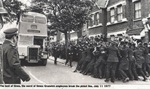
A much larger picket began assembling outside Grunwick’s premises in Willesden.
Initially these were peaceful and among those lending support were Labour MPs, including three Labour cabinet ministers, Shirley Williams, Denis Howell and Fred Mulley, all of whom were sponsored by APEX.
After the subsequent deployment of mass pickets, the police had to escort buses taking Grunwick staff to work. The road outside became a frequent flashpoint with clashes between police and pickets generating bloody scenes on tv.
Arthur Scargill, who had demonstrated the power of flying pickets at Saltley Gate in Birmingham in the 1972 miners’ striker, helped to organise a mass picket outside Grunwick on 22 June 1977.

By then he had risen to become the NUM’s Yorkshire area president, and he led the mass picket, supported by miners from Yorkshire, South Wales and Kent, as they marched towards Grunwick’s entrance.
In mid-July 1977, after 500 arrests – the most since the 1926 General Strike – and 240 police had been injured, Callaghan asked Lord Scarman to conduct his inquiry. In recognition of the Prime Minister’s intervention, the picketing was called off.
At the height of the picketing Norris McWhirter complained to Mrs Thatcher about Scargill’s ability – “toting his loud hailer” – to mobilise massive protests staged by pickets who were being paid “a daily rate” to attend.
We saw in the pit dispute how Mrs Thatcher cracked down on the strikers withdrawing social security payments for their families, on the grounds they were receiving strike pay from the NUM.
Perhaps the greatest lesson she learned from the Grunwick dispute was the need to change the law to prevent secondary picketing.
Much to her annoyance the Conservatives’ legal restraints were ignored by the NUM as it campaigned around the coalfields for men at the working pits to join the strike.
Mrs Thatcher could not be faulted on her direction and control of the government’s response to the strike. Less is known about how she worked privately behind the scenes to take direct action to help and protect the working miners.
Whenever possible she intervened personally to assist strike breakers who were being harassed during the dispute, instructing the National Coal Board to transfer men to working pits.
She liaised with leaders of the Wives’ Back to Work Campaign to prevent victimisation, in some cases urging “special treatment” to ensure men’s safety.
Unlike Norris McWhirter, who was proud in later years to publicise his strike-breaking activities at Grunwick, secrecy still surrounds the extent of Mrs Thatcher’s exploits in the miners’ strike.
When her cabinet records were published in 2014, much of the correspondence detailing what had happened was not released.
Names of those involved and the circumstances surrounding their cases were ordered to be kept secret for another 70 to 80 years.

Grunwick is still perceived as a pivotal dispute in a never-ending struggle by low-paid immigrant workers to gain reward and recognition.
Ater so many setbacks and with no-one stepping forward to take the lead, support for Mrs Desai slowly drained away.
Fearing the unions were about to declare the dispute could not be won she mounted a hunger strike outside the TUC in November 1977.
Finally, the strikers called off their action on 14 July 1978, but Mrs Desai never gave up on her own defiant campaign for the kind of union backing which she said she had been promised but which had failed to deliver.