A journalist of fifty years standing offers a personal and independent assessment of the often troubled relationship between public figures and the British news media.
My aim is to try to monitor events and issues affecting the ethics of journalism and the latest developments in the rapidly-changing world of press, television, radio and the Internet.
Expect too an insight into the black arts of media manipulation. So spin-doctors, Beware!
Journalists who reported the bitter year-long confrontation between Margaret Thatcher and Arthur Scargill will find they were well and truly duped if they care to examine newly-published cabinet records for 1983 which finally reveal the true extent of secret preparations for a possible miners’ strike.
Worse still the correspondents will realise that for much of the time during the 1984-5 pit dispute they were doing the government’s bidding by speculating about the impact of falling coal stocks and the threat of power cuts.
What the news media did not know at the time was that as early as March 1983 Mrs Thatcher had been assured that so much progress had been made in secretly converting coal fired power stations to oil that the Central Electricity Generating Board was almost on the point of guaranteeing “indefinite endurance”.
Those two words – “indefinite endurance” – meant that however long the pit strike lasted the lights would not go out. Tactically it gave Mrs Thatcher immeasurable strength and helped to explain why her government was only too happy to allow the news media to carry on highlighting Scargill’s dire warnings of disruption to electricity supplies.
Striking miners were not only defeated on the picket line – as a result of unprecedented policing – but also in a highly-effective propaganda war. Journalists never like to find that their reports were based on a misconception but that was certainly the case in the pit dispute when we reported on falling coal stocks and the potential for power cuts.
Two swiftly-executed policy retreats seem to have succeeded in elevating David Cameron’s general election strategist Lynton Crosby to a status comparable to that of Peter Mandelson, arch manipulator for Tony Blair, whose dark arts were credited with helping to steer New Labour to victory in 1997.
Coalition government U turns on plain packaging for cigarettes and minimum pricing for alcohol are both said to reflect the hidden hand of the so called “Wizard of Oz” who is reported to have told the Prime Minister that it is time to start “scraping the barnacles off the hull” in order to prepare the Conservative Party for the long haul to the 2015 general election.
Judging by the ruthless way the decks are being cleared in readiness for the 2015 campaign he is doing what Boris Johnson, the Mayor of London, says the Australian strategist does best of all: “winning out the stuff” that politicians might think is important but which does not meet the Crosby mantra that “message matters most”.
And, if the robust stances being adopted by Conservative ministers on issues such as illegal immigration and social security fraud are any guide, the ground is already being prepared for a bruising confrontation with Labour and the Liberal Democrats.
But it is the speed with which Crosby has succeeded – at least for the present – in closing down stories about the links between himself, his partner Mark Textor and the tobacco company Philip Morris Ltd – a connection first revealed by Spinwatch as long ago as 2005 – which is the clearest illustration of his likely effectiveness as “Dave’s Rottweiler”
Hacked Off and other pressure groups campaigning for the introduction of a Leveson-style press regulator are confident there will be fresh opportunities to “crank up the pressure” against the delaying tactics of press proprietors and Conservative politicians.
Supporters of the victims of press intrusion and harassment believe the Secretary of State for Culture Maria Miller has become the captive of Pressbof, which has yet again defied a cross-party agreement and is now establishing its own independent organisation to monitor press standards.
Having already outwitted the government by getting ahead of Parliament with a rival royal charter on press regulation, Pressbof is now able to take advantage of a delay until October at the earliest before the Privy Council considers the royal charter which the party leaders agreed in March and which has the support of both the Commons and the Lords.
Brian Cathcart, a founder member of Hacked Off, told the annual meeting of the Campaign for Press and Broadcasting Freedom (13.7.2013) that it was now a question of “who governed the country”. Pressbof and its allies in the Conservative Party should not imagine that the will of Parliament could be ignored by a “tiny group of powerful vested interests who have wreaked havoc in the lives of ordinary people”.
European-wide regulations to provide for the erasure of personal details stored online will not provide an absolute right to be forgotten. This was the clear warning of speakers at a conference on policy priorities for social media.
Facebook’s European director of policy Richard Allan told the Westminster eForum (10.7.2013) that although Facebook users had the right to delete their own profile it was not possible to erase all associated material held about an individual by other data controllers.
Lawyers representing social media companies urged the European Union to be much clearer in how it was proposing to enforce “a right to be forgotten”.
Hazel Grant, a commercial lawyer and partner in Bristows, said the European proposal for a right of erasure of data when consent was withdrawn could not provide an absolute right to be forgotten. The data controller concerned would have an obligation to inform third parties and ask them to erase data unless the cost was disproportionate but there was no guarantee that could be done.
“If the European Union wants to introduce a right to be forgotten it needs to be much clearer...It cannot be delivered entirely because a complete right to be forgotten would destroy history...Business needs to know how this will work”.
When the news broke in June that the Greek public broadcaster ERT had been closed down, taken off the air, I found the justification of the Greek government provided an uncanny throwback to events in Britain.
Throughout the run-up to the 2010 general election, David Cameron, as leader of the Conservative Party, had been at the forefront of the demands to freeze the BBC licence fee.
Within three months of taking office, the coalition government formed by the Conservatives and Liberal Democrats had imposed a 20 per cent reduction in the BBC’s spending.
The Greek’s government’s official spokesman accused ERT of being “a haven of waste”. He said it had displayed “an exceptional lack of transparency” and had done nothing to end “incredible extravagance”.
Conservative politicians promoted a similar line when the Chancellor of the Exchequer George Osborne justified his October 2010 spending review which included a six-year freeze on the BBC’s licence fee, cutting the the BBC’s income by £1 billion a year by 2015.

 A journalist of fifty years standing offers a personal and independent assessment of the often troubled relationship between public figures and the British news media.
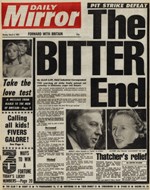 Journalists who reported the bitter year-long confrontation between Margaret Thatcher and Arthur Scargill will find they were well and truly duped if they care to examine newly-published cabinet records for 1983 which finally reveal the true extent of secret preparations for a possible miners’ strike.
 Two swiftly-executed policy retreats seem to have succeeded in elevating David Cameron’s general election strategist Lynton Crosby to a status comparable to that of Peter Mandelson, arch manipulator for Tony Blair, whose dark arts were credited with helping to steer New Labour to victory in 1997.
 Hacked Off and other pressure groups campaigning for the introduction of a Leveson-style press regulator are confident there will be fresh opportunities to “crank up the pressure” against the delaying tactics of press proprietors and Conservative politicians.
 European-wide regulations to provide for the erasure of personal details stored online will not provide an absolute right to be forgotten. This was the clear warning of speakers at a conference on policy priorities for social media.
 When the news broke in June that the Greek public broadcaster ERT had been closed down, taken off the air, I found the justification of the Greek government provided an uncanny throwback to events in Britain.