A journalist of fifty years standing offers a personal and independent assessment of the often troubled relationship between public figures and the British news media.
My aim is to try to monitor events and issues affecting the ethics of journalism and the latest developments in the rapidly-changing world of press, television, radio and the Internet.
Expect too an insight into the black arts of media manipulation. So spin-doctors, Beware!
Margaret Thatcher’s demolition job on the industrial might of the British trade union movement helped to generate not only an economic revolution but has also contributed to a transformation in the way the news media reports the world of work.
Journalists who covered the big industrial disputes of the Thatcher decade ended up writing themselves out of the script and by the late 1980s financial news from the City of London had increasingly taken the place of reportage about employment issues and union affairs.
Millions of days a year were being lost through strike action during the 1970s – an era of union militancy which culminated in the so called “winter of discontent” of 1978-9 – but by the end of her Premiership stoppages were a fraction of what they had once been.
Slowly but surely the unions’ strike weapon had been emasculated. Strike ballots were required by law; walk-outs were no longer possible on a show of hands in a car park; flying pickets and secondary action had been outlawed; and most importantly of all a union’s assets were at risk if there was “unlawful” action, as the NUM President Arthur Scargill discovered to his cost in the 1984-5 pit dispute.
Scargill, like other union leaders of his era, had grown used under the previous Labour governments of Harold Wilson and James Callaghan to employers giving way but Mrs Thatcher, backed by a largely supportive national press was able to prove that the disputes of the 1980s would be won or lost not just on the picket line but also on the back of public opinion and much of the media’s coverage was turned against the unions.
One survivor of the Thatcher decade whose voice was not heard reflecting on the death of the former Prime Minister was that of Arthur Scargill, leader of the National Union of Mineworkers during the fateful pit dispute of 1984-5.
Scargill, now 75, has refused all requests to comment on Margaret Thatcher’s Premiership and his epic struggle with her government. However hard the news media might try, the former NUM President has no intention of assisting journalists to put a post-Thatcher spin on the devastation suffered by the mining communities.
His former wife Anne Scargill had no hesitation in describing how she felt "really, really happy" on hearing the news of Lady Thatcher's death: "She has smashed our communities...she was evil...she has closed our manufacturing industry, she has closed our mines; we are short of fuel, she was intent on smashing the trade uions and she in the end smashed the country."
But from the miners' leader himself there has been no reaction. Comments on his name on Twitter were not found to have been verified and it was left to miners' leaders in the former coalfields to defend the strike.
The lack of response on Scargill's part is not unusual. In recent years he has rarely answered reporters’ questions and made a point of not talking about either himself or his health; he does appear occasionally in public at miners’ events and has also been engaged in a protracted court case over his continued use of a union owned flat in London’s Barbican.
I could not help but reflect of Scargill’s absence as I spent two hours on the BBC’s local radio circuit the morning after her death (9.4.2013), giving interviews to the local radio stations serving the former coalfields of Yorkshire and Nottinghamshire. The presenters told their listeners Scargill had rejected all requests for interviews and they asked me why.
Personally I was not at all surprised by Scargill’s response. There was no way he was going to be tempted to dance on Lady Thatcher’s grave because he knew he would be forced to try to defend the strike he led, his union’s crushing defeat and the subsequent devastation of the mining communities.
Margaret Thatcher’s decade in power resulted in an economic revolution in the United Kingdom...and also changed the face of the British news media. So successful was she in defeating the trade union movements and in privatising the nationalised industries that a band of reporters who had once ruled the roost ended up writing themselves out of the script.
The Lost Tribe: Whatever Happened to Fleet Street’s IndustrialCorrespondents? is the title of the book I published in 2011 charting the demise of the journalists who had hogged the headlines for decades but who then disappeared almost without trace from the reportage of daily news.
Their downfall was not simply the result of the dramatic decline in the number of all-out strikes but also the corresponding and spectacular growth of the City of London and the emerging dominance of financial news.
Margaret Thatcher’s step-by-step assault on trade union power and the break-up of loss-making nationalised industries had terrible consequences for Britain’s industrial heartlands: empty factories, mass redundancies and an unemployment rate that topped three million left terrible scars, not least in the mining communities ravaged by pit closures.
Union membership topped twelve million in the final year of the Wilson-Callaghan government but it was the prolonged strike action of the so-called “winter of discontent” in 1978-79 which paved the way for Margaret Thatcher’s general election victory.
A failure to avoid an ill-judged photo-opportunity – or an inability to exploit unexpected mishaps – is often a pointer to the chances of eventual success in British politics.
David Miliband’s inept appearance at the 2008 Labour Party conference – walking along holding up a banana in his hand – was instantly captured by photographers and was an image which came back to haunt him.
Indeed the former Labour Foreign Secretary – now to be the new chief executive of the International Rescue Committee, a leading American humanitarian charity – never seemed entirely at home in the cut-and-thrust of the cruel interface between British politics and an unforgiving news media.
Today’s politicians, as demonstrated so colourfully by the Mayor of London Boris Johnson, have to always have an eye on how their every move in public is likely to interpreted – or misinterpreted – by the tabloid press.
David Miliband’s goofy photo-opportunity was a political car crash. It provided the most unforgettable, and much reproduced, image of the 2008 party conference season and came to symbolise his lack of a killer instinct.
When the chips had been down earlier that summer, when Gordon Brown was floundering as Labour Prime Minister, Miliband fluffed his chance to launch a bid for the Labour leadership; he showed he was no Michael Heseltine, more of a Michael Portillo
A Budget leak by the London Evening Standard – listing on Twitter the key changes to be made by the Chancellor of the Exchequer George Osborne – has lifted the lid on the lengths to which successive governments have gone in manipulating the presentation of financial announcements.
By mistakenly tweeting its own front page splash on the Budget twenty minutes before the Chancellor had even started his speech, the Evening Standard inadvertently confirmed the extent of the collusion between the Treasury and selected political correspondents.
Why, might one ask, would a Chancellor want his officials to give exclusive details of his Budget in advance to an evening newspaper in London?
The answer is simple: the Evening Standard presents the City of London’s financial markets – and the rest of the news media – with the first considered impression of the announcements in the Chancellor’s red Budget box.
No spin doctor would dare to under estimate the potential impact of the Evening Standard’s front page; after all this is the first serious assessment of the Chancellor’s announcements.
By mid afternoon on Budget days, within an hour or so of the speech, copies of the Evening Standard are landing on the London news desks of national newspapers and radio and televisions newsrooms. An image of the front page might well be reproduced in the early evening news bulletins – and if all the Treasury briefings have gone to plan – the thumbs up from the Evening Standard will, so the government hopes, have a positive influence on other journalists.

 A journalist of fifty years standing offers a personal and independent assessment of the often troubled relationship between public figures and the British news media.
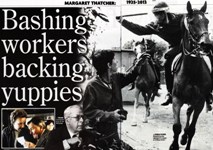 Margaret Thatcher’s demolition job on the industrial might of the British trade union movement helped to generate not only an economic revolution but has also contributed to a transformation in the way the news media reports the world of work.
 One survivor of the Thatcher decade whose voice was not heard reflecting on the death of the former Prime Minister was that of Arthur Scargill, leader of the National Union of Mineworkers during the fateful pit dispute of 1984-5.
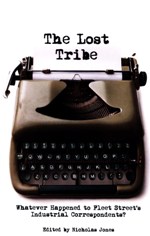 Margaret Thatcher’s decade in power resulted in an economic revolution in the United Kingdom...and also changed the face of the British news media. So successful was she in defeating the trade union movements and in privatising the nationalised industries that a band of reporters who had once ruled the roost ended up writing themselves out of the script.
  A failure to avoid an ill-judged photo-opportunity – or an inability to exploit unexpected mishaps – is often a pointer to the chances of eventual success in British politics.
 A Budget leak by the London Evening Standard – listing on Twitter the key changes to be made by the Chancellor of the Exchequer George Osborne – has lifted the lid on the lengths to which successive governments have gone in manipulating the presentation of financial announcements.